Qualcomm Dual-Band Industrial Motherboard Mesh Networking Industrial Intelligent Networking Core Hardware Solution
The deep implementation of smart manufacturing and the Industrial Internet of Things (IIoT) has significantly increased the dependence of industrial sites on wireless communication. However, three major pain points—stuttering in multi-device concurrent transmission, unstable communication in complex industrial environments, and difficulties in adapting to harsh power supply and electromagnetic conditions—have consistently restricted the efficiency and stability of industrial wireless networking. Traditional commercial wireless modules struggle to meet the high requirements of industrial scenarios, making industrial-grade wireless communication core hardware a rigid demand in the industry.
The High-Performance WIFI5 Dual-Band Industrial Motherboard PCBA, as a Qualcomm chipset-based industrial-grade wireless communication core module, is designed specifically for industrial wireless communication pain points and positioned as the core hardware carrier for industrial intelligent networking. With its flexible adaptability of dual-band communication, industrial-grade environmental reliability, multi-mode networking capabilities, and open system platform support, the product can fully meet the wireless communication needs of smart manufacturing and IIoT scenarios, creating stable, efficient, and implementable wireless networking solutions for industrial enterprises.
Chapter 1: Product Core Positioning and Core Hardware Configuration
1.1 Product Core Positioning
A WIFI5 Dual-Band Small Industrial Motherboard Module PCBA that can be flexibly deployed as a Qualcomm AP coverage device or a CPE embedded module. It is the core hardware carrier for industrial site wireless communication. Designed specifically for industrial scenarios, it can be directly integrated into industrial intelligent equipment, providing stable hardware support for industrial wireless networking and device-to-device data interaction. It is the core communication module for the Industrial Internet of Things and smart manufacturing.
1.2 Core Hardware Chipset Solution
The product adopts the Qualcomm IPQ4019+QCA8075 original chipset combination as the core computing power carrier for industrial wireless communication. This solution combines strong compatibility, high stability, and excellent wireless transmission capabilities. Verified in industrial scenarios, it effectively avoids disconnection and stuttering issues common with commercial chips in industrial environments, perfectly adapting to the high requirements of industrial-grade wireless communication.
The storage configuration features 32MB NOR FLASH + 256M DDR. The 32MB NOR FLASH provides secure storage and upgrade space for firmware, ensuring the stability of the industrial system firmware; the 256M DDR achieves high-speed data caching, meeting the large data processing needs during multi-device concurrent transmission at industrial sites. This dual configuration supports the product’s long-term stable operation in industrial environments.
1.3 Product Physical Specifications
Adopting a compact design with dimensions of only 106 x 80 x 17mm and a weight of 56g, its small and portable characteristics allow the product to be easily embedded into various industrial equipment such as industrial robots, inspection equipment, and intelligent controllers without requiring large installation spaces, greatly improving the flexibility of industrial equipment integration.
The product possesses rigorous industrial-grade environmental adaptability, with an operating temperature range of -20~+65℃ and humidity support of 5%~95% non-condensing. It can be directly deployed in harsh industrial environments such as outdoors, mine tunnels, utility tunnels, and high-temperature workshops without additional temperature and humidity protection devices, significantly reducing deployment costs at industrial sites.
Chapter Summary
As an industrial-grade wireless communication core hardware carrier, it is equipped with Qualcomm IPQ4019+QCA8075 original chipsets and high-spec storage, ensuring stable hardware performance. Its compact design is suitable for embedded integration in industrial equipment, and its wide temperature and humidity industrial-grade characteristics allow direct deployment in various harsh industrial environments.
Chapter 2: Detailed Explanation of Core Functions and Wireless Communication Performance
2.1 Dual-Band Wireless Communication Core Parameters
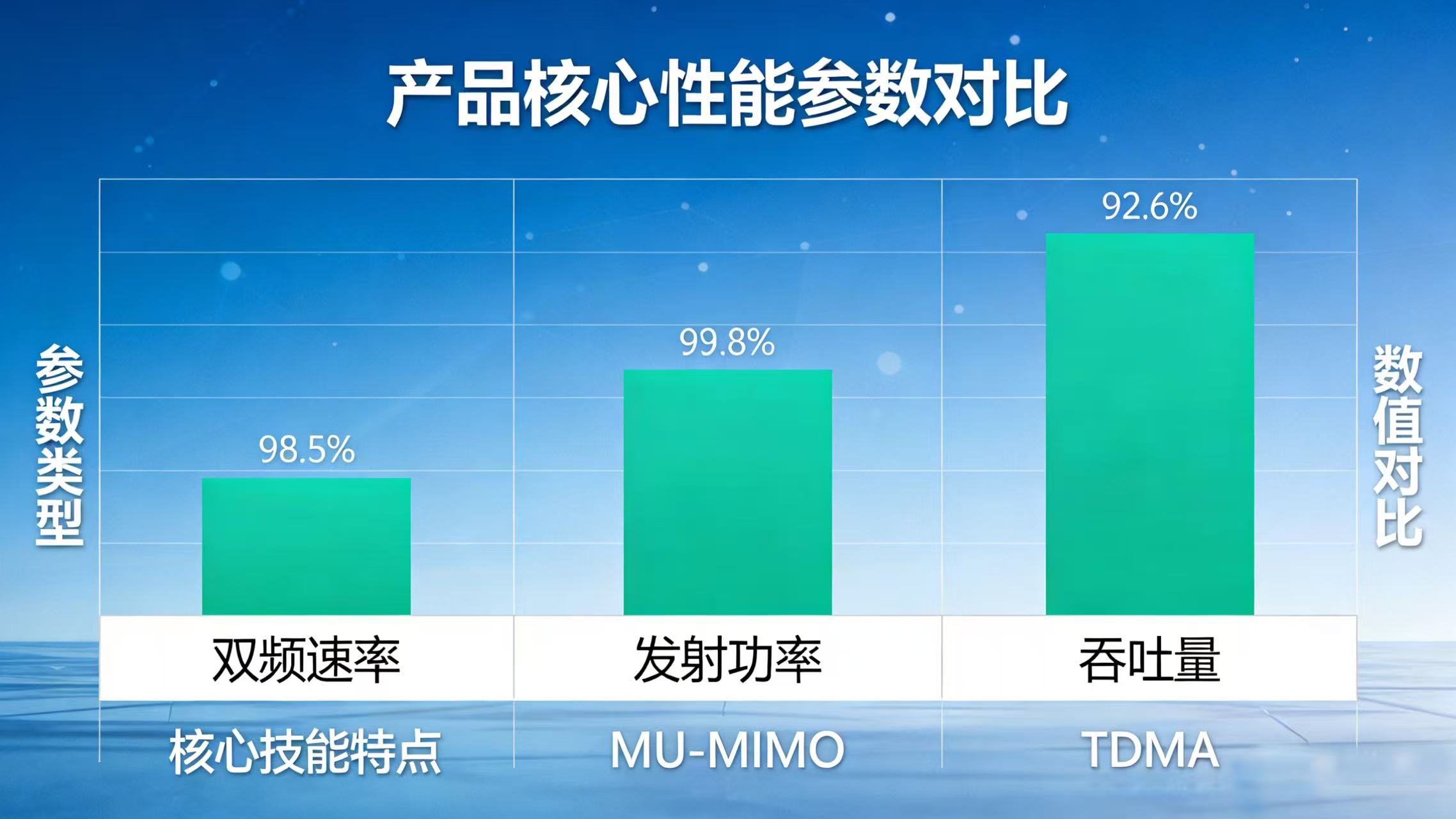
Adopting a 2.4GHz (802.11N) + 5GHz (802.11ac Wave2.0) dual-band wireless communication design, each frequency band has its advantages, adapting to the transmission needs of different industrial sites: the 2.4GHz band has strong wall penetration capabilities and long signal coverage distance, suitable for dispersed industrial sites with long distances and multiple obstructions like mine tunnels and large factories; the 5GHz band features high speed, strong anti-interference, and no co-channel interference, suitable for industrial scenarios with high speed requirements such as AI visual backhaul and large data volume sensor data transmission.
The product’s dual-band parameters are precisely adapted to industrial needs. The 2.4GHz band range is 2412MHz-2462MHz, and the 5GHz band range is 5180-5825MHz. Both bands support 23dBm transmit power. The wireless rate can reach 1750Mbps, with an effective throughput of 600Mbps, meeting the high-speed transmission needs of multiple data types such as high-definition video, control instructions, and sensor data at industrial sites.
At the same time, the product supports flexible switching of 20M/40M/80M bandwidths. Small bandwidths (20M/40M) adapt to low-bandwidth, long-distance transmission scenarios, such as simple instruction interaction between mine tunnel equipment; large bandwidths (80M) adapt to large data volume, high-speed transmission scenarios, such as real-time high-definition video backhaul from industrial AI visual cameras. Flexible bandwidth switching allows the product to dynamically adjust according to industrial scenario needs, improving communication efficiency.
2.2 Core Wireless Technology Features
In unmanned factories, how to avoid communication stuttering when multiple robots work simultaneously? The MU-MIMO technology (Multi-User Multiple-Input Multiple-Output) provides the answer. This technology allows the product to establish independent communication connections with multiple industrial intelligent devices simultaneously, achieving multi-device concurrent access and data transmission, avoiding transmission stuttering caused by a single device occupying the entire bandwidth, significantly improving communication efficiency in multi-device scenarios, and perfectly adapting to industrial scenarios where sorting robots and AGV unmanned vehicle clusters work together.
Addressing the transmission delay problem caused by multi-device channel competition at industrial sites, the product is equipped with TDMA (Time Division Multiple Access) technology. This technology allocates exclusive communication channels to different industrial devices in chronological order, allowing each device’s communication data to be transmitted sequentially, fundamentally solving the channel competition problem, improving the real-time performance and stability of data transmission, and adapting to scenarios with extremely high real-time communication requirements such as industrial robots and inspection equipment.
The product also features high-speed seamless roaming capabilities. The roaming handover latency is low, ensuring that mobile industrial equipment such as AGV unmanned vehicles and in-plant sorting robots maintain uninterrupted wireless connections during high-speed movement within the factory area. Control instructions and data transmission remain continuous and stable, avoiding downtime caused by device movement and ensuring the continuity of industrial production.
2.3 Industrial-Grade Circuit Design
The product follows the intrinsically safe power delivery device design specifications (Note: Intrinsic safety certification has not been performed and needs to be applied for independently). The circuit design adopts an anti-electromagnetic interference scheme, effectively reducing the impact of electromagnetic interference generated by equipment such as frequency converters and large machine tools at industrial sites on wireless communication, ensuring communication stability in complex electromagnetic environments, and adapting to strict electromagnetic conditions at industrial sites.
The power supply scheme supports DC 9-48V direct current power supply and 15-24V/48V standard PoE power supply (choose one of two). The dual power supply scheme adapts to diverse power supply needs at industrial sites. Whether it is standard DC power supply in workshops or PoE power supply in scenarios where wiring is difficult such as outdoors and utility tunnels, the product can perfectly adapt. At the same time, PoE power supply achieves “power + data transmission over a single network cable”, significantly simplifying the wiring process at industrial sites and reducing construction and maintenance costs.
| Frequency Band | Core Standard | Core Advantages | Adapted Industrial Scenarios | Recommended Bandwidth |
|---|---|---|---|---|
| 2.4GHz | 802.11N | Strong wall penetration, long range, anti-interference | Mine/Utility tunnel communication, outdoor equipment networking, long-distance instruction interaction | 20M/40M |
| 5GHz | 802.11ac Wave2.0 | High speed, high throughput, no co-channel interference | AI visual backhaul, robot cluster communication, large data volume sensor transmission | 80M |
Chapter Summary
Dual-band design flexibly adapts to different industrial transmission needs, and multi-level bandwidth supports dynamic adjustment; core technologies such as MU-MIMO and TDMA solve core pain points of industrial multi-device concurrency and real-time communication; industrial-grade circuit and dual power supply schemes ensure communication stability under complex electromagnetic and power supply conditions.
Chapter 3: Rich Interfaces and Open System Platform, Adapting to Flexible Integration Needs
3.1 Full-Function Built-in Interface Configuration
Equipped with full-function built-in interfaces covering all needs for industrial site integration, networking, debugging, and expansion. Specific interfaces and their industrial application values are as follows:
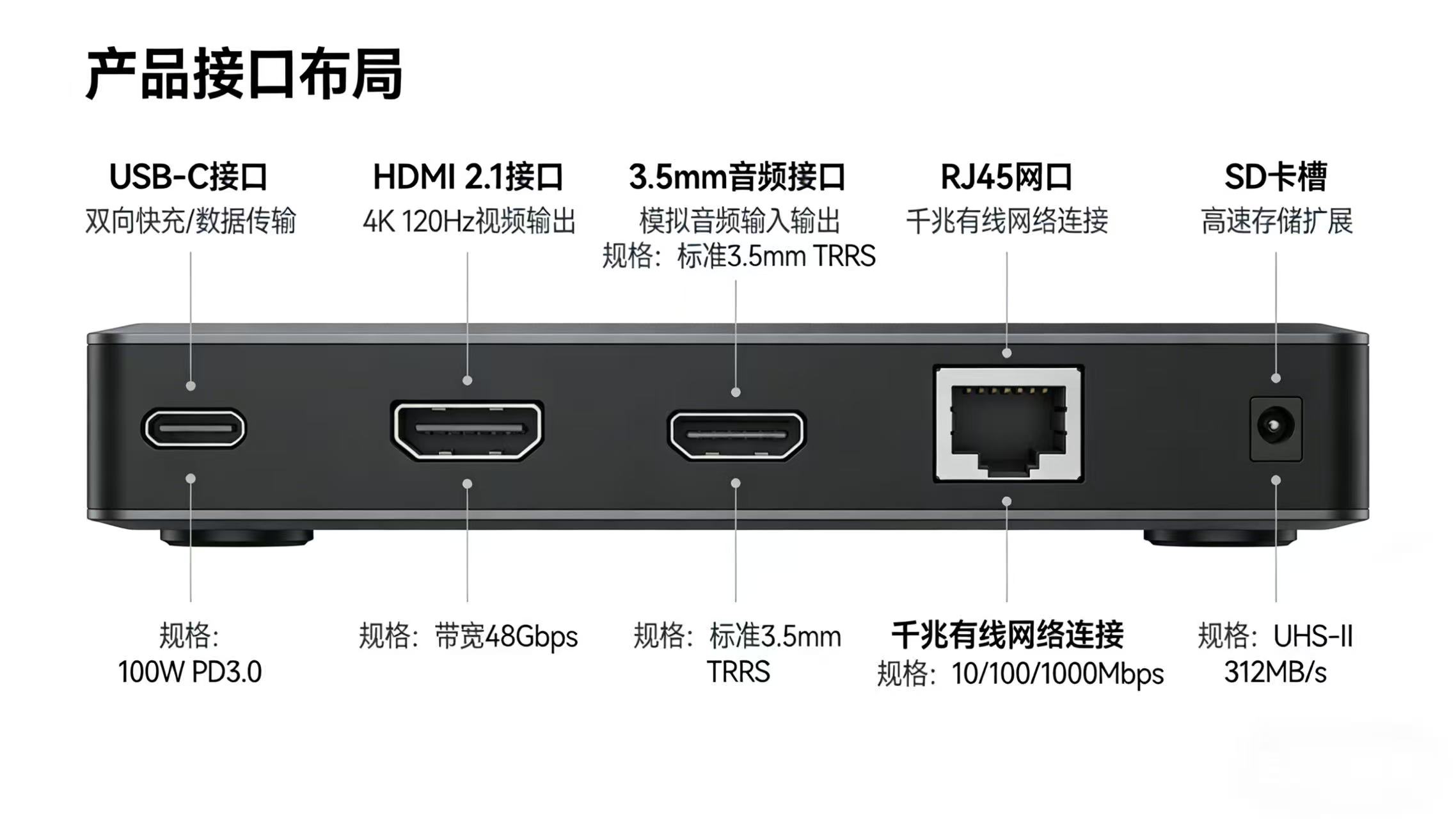
- 1000M RJ45*2: Dual gigabit Ethernet ports ensure industrial wired high-speed networking, enabling wired and wireless dual-network backup to improve industrial communication reliability, and supporting multi-device wired cascading;
- DC*1: DC power interface, adapting to standard industrial site DC power supply, making power connection simple and convenient;
- USB*1: For connecting external storage, wireless network cards, and other peripherals, achieving local industrial data storage or wireless communication expansion;
- E-JA*1: Industrial-grade expansion interface, supporting customized connection with specialized industrial equipment;
- U.FL*4: External antenna interfaces, supporting high-gain industrial antennas to expand wireless signal coverage range, adapting to long-distance scenarios such as large industrial parks and mine tunnels;
- SD*1 Card Slot: For external SD cards, achieving local caching and storage of massive industrial site data to avoid data loss;
- GPIO Expansion: Supports flexible connection with industrial sensors, actuators, controllers, and other peripherals, achieving intelligent linkage and data acquisition of industrial equipment;
- TTL Debug Interface: Convenient for engineers to perform on-site debugging and equipment maintenance, quickly troubleshooting issues and reducing maintenance costs at industrial sites.
3.2 Open System and Configuration Platform
The product is equipped with an open system platform that balances security and secondary development capabilities, supporting three major systems: WEB Uboot (Immortal Uboot), MESHCOM, and OpenWrt. WEB Uboot (Immortal Uboot) ensures the security of firmware flashing; even if an abnormality occurs during flashing, it will not cause the device to be scrapped, avoiding losses caused by firmware upgrade failures at industrial sites. The MESHCOM system is designed specifically for industrial Mesh networking, optimizing the stability and self-healing capabilities of multi-node interconnection. The OpenWrt open-source platform supports enterprise secondary development, allowing customization of functions according to their own industrial scenario needs, adapting to personalized industrial wireless communication requirements.
The configuration method adopts WEB Visual Configuration. Engineers can complete all parameter configurations of the product through a browser. The operation interface is simple and intuitive, requiring no professional programming skills, significantly lowering the debugging threshold at industrial sites and improving configuration efficiency, so that even non-professional engineers can get started quickly.
Addressing data security needs in industrial scenarios, the product supports WAPI AP and Client (optional encryption chip). As a national cryptographic standard for wireless encryption, WAPI can achieve encrypted transmission of industrial wireless communication data, effectively preventing the leakage of core data such as industrial production data and device control instructions, improving the security of industrial wireless communication, and adapting to smart manufacturing enterprises with high data security requirements.
3.3 Customized Service Capabilities
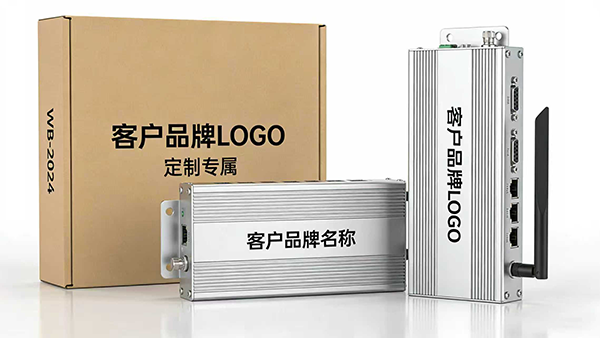
To meet the personalized scenario needs of different industrial enterprises, the manufacturer provides full-dimensional customization services, covering three major aspects: equipment form factor, function, and software. Product dimensions can be customized according to the installation space of industrial equipment to achieve perfect embedding; core functions can be customized according to industrial scenario needs, such as removing redundant interfaces or strengthening specific communication capabilities; software customization development can be performed according to enterprise needs, optimizing networking algorithms and adapting to exclusive industrial equipment.
At the same time, the manufacturer also provides bare board and integrated technical solution guidance, and complete machine application technical support, possessing a professional technical team to provide enterprises with full-process technical guidance from product selection and embedded integration to on-site deployment, solving various technical problems during the product application process, significantly lowering the integration and application threshold for enterprises, and enabling industrial enterprises to quickly achieve wireless networking implementation.
Chapter Summary
Equipped with full-function interfaces covering all needs for industrial integration, networking, debugging, and expansion; an open system platform balancing secure flashing and secondary development; WEB visual configuration lowers the debugging threshold; full-dimensional customization services and professional technical support adapt to enterprise personalized industrial scenario needs.
Chapter 4: Multi-Type Networking Schemes, Creating a Full Solution for Industrial Site Wireless Communication
4.1 Core Networking Capabilities
Possessing powerful general networking capabilities, supporting multi-mode wireless transmission, it can establish stable communication bridges between industrial networks of two or more different network segments, achieving data intercommunication and instruction interaction for industrial equipment across different network segments. It perfectly adapts to complex and diverse network topology needs at industrial sites and acts as a “universal hardware carrier” for industrial wireless networking, meeting full-scenario networking needs from single-device direct connection to park-level multi-device interconnection.
4.2 Detailed Explanation of Five Major Networking Schemes
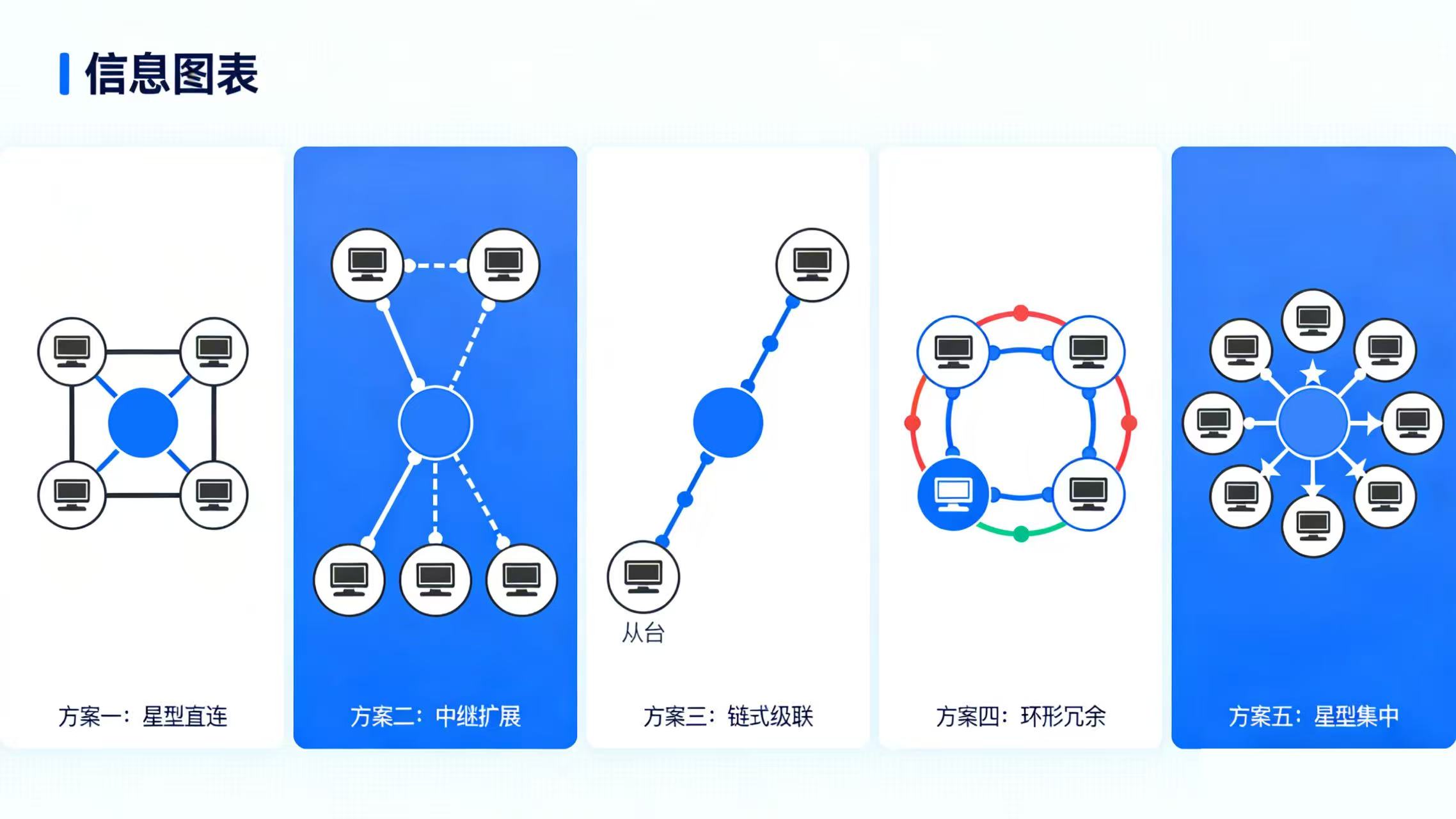
| Networking Scheme | Networking Structure | Core Advantages | Transmission Latency | Adapted Industrial Scenarios |
|---|---|---|---|---|
| Point-to-Point (P2P) | Node A + Node B Direct Connection | High speed, low latency, simple deployment | <10ms | Between mine tunnel construction equipment, outdoor pump stations and control terminals, two large devices directly connected |
| Relay Networking | Node A + Node C Relay + Node B | Extends transmission distance, solves communication blind spots | <20ms | Large factories, urban utility tunnels, industrial sites with walls/equipment obstructions |
| Multi-Hop Relay Networking | Node A + Multi-Node Step-by-Step Relay + Node B | Ultra-long distance transmission, adapts to multiple segments of obstruction | <50ms | Ultra-large industrial parks, long-distance mine tunnels/utility tunnels, outdoor large engineering sites |
| Point-to-Multipoint (P2MP) | Node C Master + Multiple Slave Nodes | Centralized management, concise networking, convenient maintenance | <15ms | Workshop robot clusters, AGV unmanned vehicles and central control rooms, multi-sensor data acquisition |
| MESH Networking | Core Node + Multi-Node Interconnection (Any node can relay) | Self-organizing, self-healing, extremely strong stability | <30ms | Unmanned factories, park-level industrial intelligent equipment interconnection, large utility tunnel inspection |
1. Point-to-Point (P2P) Networking
Point-to-Point networking is the most basic wireless networking method, consisting of two directly connected nodes without other relay equipment. It is simple to deploy and low cost. This scheme’s direct connection characteristic gives it the advantages of high speed and low latency, enabling high-speed data interaction and real-time instruction transmission between industrial equipment. It adapts to long-distance, one-to-one industrial communication scenarios such as between mine tunnel construction equipment, outdoor pump stations and control terminals, and direct connection of two large industrial devices.
2. Relay Networking
Addressing the communication blind spot problem caused by obstructions at industrial sites, relay networking adds a relay node on the basis of point-to-point networking. It consists of three parts: source node, relay node, and target node. The relay node can receive the signal from the source node and amplify/forward it to the target node, effectively extending the transmission distance and solving communication blind spots at industrial sites. This scheme adapts to large factories, urban utility tunnels, and industrial sites with walls/large equipment obstructions, allowing wireless signals to cover every corner of the industrial site.
3. Multi-Hop Relay Networking
Multi-hop relay networking is an extension of relay networking. Depending on the distance and obstruction conditions of the industrial site, multiple relay nodes can be added to achieve multi-node step-by-step relay transmission. This scheme adapts to complex industrial sites with ultra-long distances and multiple segments of obstruction, capable of transmitting wireless signals to industrial equipment kilometers away, perfectly solving wireless communication problems in ultra-large industrial parks, long-distance mine tunnels/utility tunnels, and outdoor large engineering sites.
4. Point-to-Multipoint (P2MP) Networking
Point-to-Multipoint networking consists of one master node and multiple slave nodes. The master node acts as the core control node, responsible for centralized management of all slave nodes. Slave nodes establish wireless connections with the master node to achieve data interaction and instruction transmission. This scheme features concise networking and convenient maintenance. Engineers can uniformly configure and manage all slave nodes through the master node, significantly reducing networking and maintenance costs at industrial sites. It adapts to scenarios involving communication between multiple devices and a core control terminal, such as workshop sorting robot clusters, AGV unmanned vehicles and central control rooms, and multi-industrial sensor data acquisition.
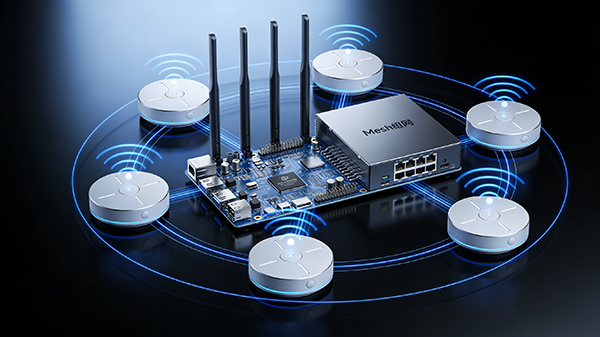
5. MESH Networking
MESH networking is a high-end networking method designed for park-level industrial intelligent networking. It consists of a core node and multiple sub-nodes. All nodes are interconnected, and any node can serve as a relay node to forward signals, possessing core advantages of self-organizing and self-healing. When a node fails, the system automatically re-plans the communication path, and other nodes can replace the faulty node to complete signal forwarding, ensuring that the overall network is not interrupted and stability is extremely strong. This scheme adapts to industrial scenarios with extremely high requirements for network stability, such as unmanned factories, park-level industrial intelligent equipment interconnection, and large utility tunnel inspection.
Chapter Summary
Supports five major networking modes: Point-to-Point, Relay, Multi-hop Relay, Point-to-Multipoint, and MESH, covering all network topology needs from single-device direct connection to park-level interconnection at industrial sites; each networking scheme has its own advantages and can be flexibly selected according to industrial scenario requirements such as distance, obstruction, and device quantity, and all schemes feature low latency, adapting to industrial real-time communication needs.
Chapter 5: Full-Scenario Industrial Intelligent Applications, Empowering Smart Manufacturing Implementation
5.1 Core Industrial Application Scenario Breakdown
Application Case 1: Auto Manufacturing Unmanned Factory AI Visual Backhaul and Robot Communication
A large automobile manufacturing enterprise built an unmanned factory with 20 welding robots, 10 AGV unmanned vehicles, and 15 AI visual inspection cameras deployed in the workshop. There were three major problems: AI visual HD video backhaul stuttering, robot cluster communication latency, and unmanned vehicle movement disconnection. By integrating the Industrial Motherboard into all equipment and adopting a MESH Networking + Point-to-Multipoint Networking hybrid scheme, the high-speed characteristics of the 5GHz band were utilized to achieve real-time HD video backhaul for AI visual cameras (no stuttering, latency <20ms). Relying on MU-MIMO and TDMA technologies, concurrent stable communication for 30 intelligent devices was achieved, and high-speed seamless roaming characteristics ensured continuous communication for AGV unmanned vehicles. After the solution was implemented, workshop equipment communication efficiency increased by 80%, production failure rate decreased by 60%, significantly improving the production efficiency of the unmanned factory.
Application Case 2: Urban Utility Tunnel Inspection Robot Remote Control
An urban utility tunnel maintenance enterprise has a tunnel length of 5 kilometers and deploys 5 inspection robots inside. Problems included communication blind spots in the tunnel, unstable communication due to harsh environments, and high robot control latency. By deploying one unit every 1 kilometer as a relay node in the tunnel and integrating the core module into the robots, a Multi-Hop Relay Networking scheme was adopted. Utilizing the product’s -20~+65℃ wide temperature characteristics and anti-electromagnetic interference design, full-area wireless signal coverage within the tunnel was achieved, ensuring remote real-time control and environmental data backhaul for inspection robots (latency <40ms). After the solution was implemented, the control precision of tunnel inspection robots increased by 90%, achieving unmanned intelligent inspection of the tunnel, and maintenance costs were reduced by 70%.
1. Industrial Site AI Visual Backhaul
Industrial AI visual inspection is a core link in smart manufacturing, but its HD image/video transmission places extremely high demands on wireless communication speed and throughput. Traditional wireless modules are prone to backhaul stuttering and high latency. Utilizing the high-speed characteristics of the 5GHz band 802.11ac Wave2.0 and effective throughput of 600Mbps, real-time backhaul of HD images/videos from AI visual cameras can be achieved with no stuttering and low latency, providing stable wireless communication support for industrial visual inspection and on-site real-time monitoring, adapting to AI visual inspection scenarios in industries such as automobile manufacturing, 3C electronics, and machining.
2. Sorting Robot Data Interaction
Sorting robot cluster work is a common scenario in logistics warehousing and manufacturing workshops. Multiple robots communicating with the central control terminal simultaneously can easily lead to channel competition and transmission stuttering, affecting robot collaborative work efficiency. Relying on MU-MIMO and TDMA technologies, concurrent stable access for multiple sorting robots can be achieved. Each robot has an exclusive communication channel, ensuring interference-free and zero-latency data interaction, guaranteeing the collaborative work efficiency of robot clusters, adapting to sorting robot cluster communication scenarios in logistics warehousing and manufacturing workshops.
3. In-Plant Unmanned Vehicle Communication
Mobile equipment such as AGV unmanned vehicles and in-plant transport unmanned vehicles need to maintain continuous communication with the central control terminal during operation. Traditional wireless modules are prone to roaming disconnection issues due to device movement, leading to unmanned vehicle downtime. High-speed seamless roaming characteristics allow unmanned vehicles to quickly switch to wireless nodes with stronger signals during high-speed movement within the factory area. Roaming handover latency is low, wireless connection is uninterrupted, and control instructions and data transmission remain continuous and stable, ensuring the continuous work of in-plant unmanned vehicles, adapting to in-plant unmanned vehicle communication scenarios in manufacturing and logistics warehousing.
4. Utility Tunnel / Mine Tunnel Inspection Robot Remote Control
Scenarios such as urban utility tunnels and mine tunnels face problems such as large temperature and humidity changes, complex electromagnetic environments, and communication obstructions. Furthermore, remote control of inspection robots demands extremely high stability and real-time performance of communication. Relying on -20~+65℃ wide temperature characteristics, anti-electromagnetic interference circuit design, and multi-hop relay networking capabilities, it can perfectly adapt to the harsh environments of utility tunnels/mine tunnels, achieving remote real-time control of inspection robots and stable backhaul of environmental data (temperature, humidity, harmful gases, video), ensuring the work efficiency and safety of inspection robots.
5. Mine Tunnel Construction Wireless Networking
Mine tunnel construction scenarios not only have harsh environments but also face problems such as strict power supply conditions, strong electromagnetic interference, and long-distance communication. Traditional wireless communication equipment is difficult to adapt. Following intrinsically safe power delivery device design specifications, it can adapt to the strict power supply and electromagnetic conditions of mine tunnels, supporting DC 9-48V wide voltage power supply. At the same time, adopting multi-hop relay networking achieves full-area wireless signal coverage within the mine tunnel, enabling stable wireless communication between construction equipment and between construction equipment and ground control terminals, adapting to the wireless networking needs of mine tunnel construction.
6. Unmanned Factory Intelligent Equipment Interconnection
The core of an unmanned factory is the interconnection and collaborative work of all intelligent equipment, requiring a stable, reliable, and self-healing wireless network support. Adopting the MESH Networking mode, interconnection of all intelligent equipment in the unmanned factory such as robots, AGV unmanned vehicles, AI visual cameras, sensors, and controllers is achieved. Relying on the self-organizing and self-healing advantages of MESH networking, the continuous stable operation of the network is guaranteed. Even if a node fails, it will not affect the overall network, providing core wireless communication support for the stable production of unmanned factories.
5.2 Other Extended Application Scenarios
In addition to core industrial scenarios, thanks to its excellent wireless communication performance and industrial-grade reliability, it can also adapt to wireless networking needs in various commercial and public scenarios. In commercial scenarios, it can be used for wireless coverage in hotels, shopping malls, and retail chains, providing stable wireless WiFi for customers while supporting wireless networking of commercial equipment; in office scenarios, it can be used for office networking in enterprises, offices, and campuses, achieving wireless interconnection and data sharing of office equipment; in public scenarios, it can be used for wireless communication in densely populated areas such as scenic spots, train stations, and bus stations, achieving remote control and data backhaul of public equipment. The product’s multi-scenario adaptability makes it not only a core hardware for industrial intelligent networking but also a high-quality choice for wireless networking in commercial and public scenarios.
Chapter Summary
With excellent performance and networking capabilities, it adapts to six core industrial intelligent scenarios such as industrial site AI visual backhaul, sorting robot data interaction, and in-plant unmanned vehicle communication, and has been successfully implemented in industries such as automobile manufacturing and urban utility tunnel maintenance; at the same time, the product also possesses multi-scenario adaptability, covering wireless networking needs in commercial, office, and public scenarios, demonstrating strong practicality.
Chapter 6: Summary of Product Core Competitive Advantages
As a Qualcomm WIFI5 dual-band industrial-grade PCBA motherboard, it possesses significant differentiated competitive advantages in the field of industrial wireless communication. It comprehensively meets industrial intelligent networking needs from six dimensions: chipset, performance, industrial adaptation, networking, integration, and service. The core advantages are as follows:
1. Qualcomm Original Chipset Solution, Stable and Reliable Hardware Performance
Equipped with the Qualcomm IPQ4019+QCA8075 original chipset combination, verified in industrial scenarios, it features strong compatibility, stable operation, and outstanding wireless transmission capabilities. Compared with commercial chip solutions, it can better adapt to the high requirements of industrial environments, ensuring the long-term stable operation of the product from the hardware level.
2. Industrial-Grade Full-Dimensional Adaptation, Fearless of Harsh Site Environments
Possessing environmental adaptability of -20~+65℃ wide temperature and 5%~95% non-condensing wide humidity, following intrinsically safe power delivery device design specifications, with anti-electromagnetic interference and DC 9-48V/PoE dual power supply support, it can be directly deployed in various harsh industrial environments such as outdoors, mine tunnels, and utility tunnels without additional protection.
3. WIFI5 Dual-Band High Performance, Solving Core Industrial Communication Pain Points
Adopting WIFI5 dual-band communication design, wireless rate 1750Mbps, effective throughput 600Mbps, supporting 20M/40M/80M multi-level bandwidth switching; equipped with core technologies such as MU-MIMO, TDMA, and high-speed seamless roaming, fundamentally solving core pain points such as multi-device concurrent stuttering, real-time communication latency, and mobile device disconnection at industrial sites.
4. Five Major Networking Modes, Covering All Industrial Topology Needs
Supports five major networking modes: Point-to-Point, Relay, Multi-hop Relay, Point-to-Multipoint, and MESH. It can be flexibly selected according to industrial site needs such as distance, obstruction, and device quantity, covering all network topology needs from single-device direct connection to park-level interconnection, serving as a universal hardware carrier for industrial wireless networking.
5. High Flexible Integration, Adapting to Industrial Equipment Personalized Needs
Dimensions only 106 x 80 x 17mm, small and portable for easy embedded integration; equipped with full-function built-in interfaces covering all needs for industrial integration, networking, debugging, and expansion; supports OpenWrt open-source platform secondary development, allowing function customization according to enterprise needs, with extremely strong integration flexibility.
6. Full-Dimensional Customization Service, Reducing Enterprise Application Threshold
Providing full-dimensional customization services for equipment form factor, function, and software, while equipped with a professional technical team to provide enterprises with full-process technical solution guidance and complete machine application support from product selection and embedded integration to on-site deployment, solving various technical problems during the enterprise application process, and significantly reducing the integration and application threshold.
Conclusion
The High-Performance WIFI5 Dual-Band Industrial Motherboard PCBA, as a Qualcomm chipset-based industrial-grade wireless communication core module, comprehensively solves the multi-dimensional pain points of wireless communication at industrial sites from aspects such as hardware configuration, wireless performance, industrial adaptation, networking capabilities, and integration flexibility. It is the core hardware solution for industrial intelligent networking.
Against the backdrop of the rapid development of smart manufacturing and the Industrial Internet of Things, the requirements for wireless communication at industrial sites will continue to increase. Relying on its industrial-grade reliability, high-performance wireless communication capabilities, and flexible networking and integration capabilities, it will become the core hardware support for industrial enterprises to achieve wireless networking upgrades and intelligent equipment integration, empowering the deep implementation of smart manufacturing and the Industrial Internet of Things.
Product Selection Suggestion: Suitable for enterprises in smart manufacturing, Industrial IoT, utility tunnel maintenance, and mine tunnel construction with industrial wireless networking and intelligent equipment communication needs. Standardized product solutions or customized product solutions can be selected according to actual application scenarios, device quantities, transmission distances, and other needs. The manufacturer will provide full-process technical support to ensure the rapid implementation and stable operation of the solution.