Success Story: iPoll3 Case Study – Reasons for Choosing LigoDLB
Wireless Internet Service Provider (WISP) Linkfor, operating in the Belgorod region, is a client of WMD, LigoWave’s distributor in Russia. Linkfor has over 3300 business customers in total, 345 of which are connected using LigoWave equipment.
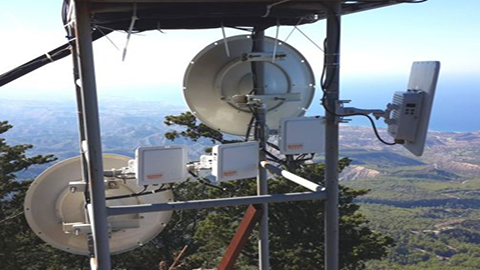
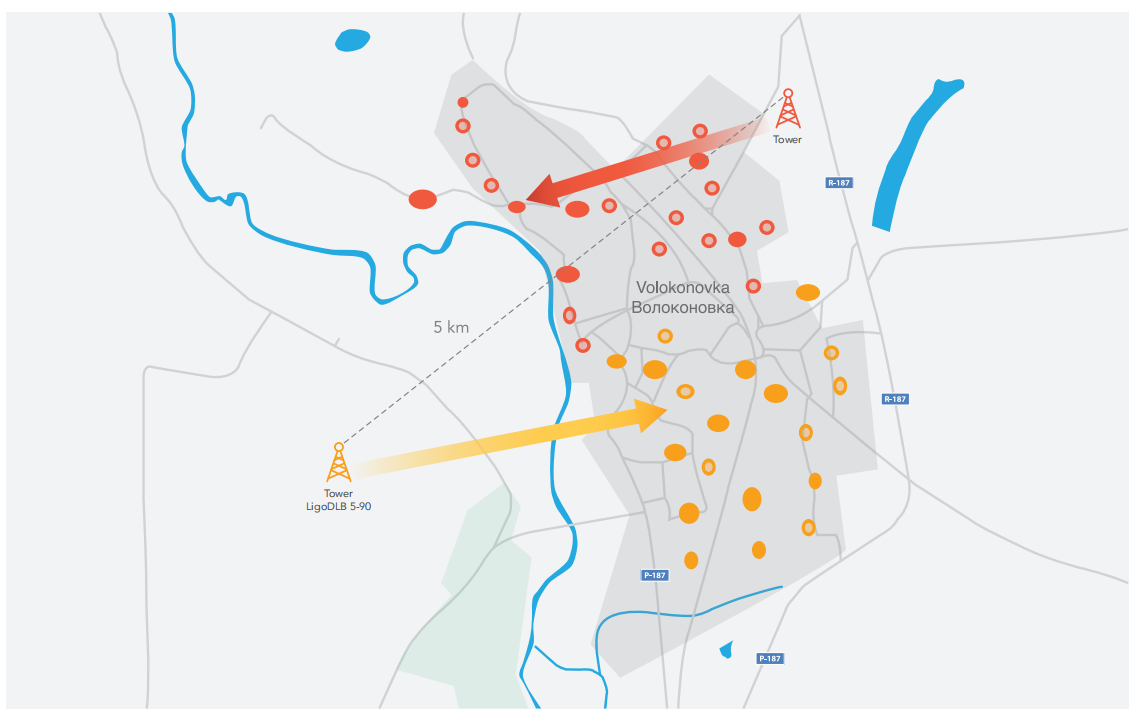
Linkfor recently established a network where 72 CPEs connect to a LigoDLB 5-90 base station, which is equipped with an integrated dual-polarization 90-degree sector antenna. The base station features an 18 dBi dual-polarization 90° sector antenna. All CPEs used in this network are LigoDLB 5-15s. These devices all operate in iPoll 3 mode. LigoWave’s iPoll 3 PTMP (Point-to-Multi-Point) proprietary protocol is an innovative solution that eliminates transmission congestion and close-range cluster interference generated in PTMP wireless installations.
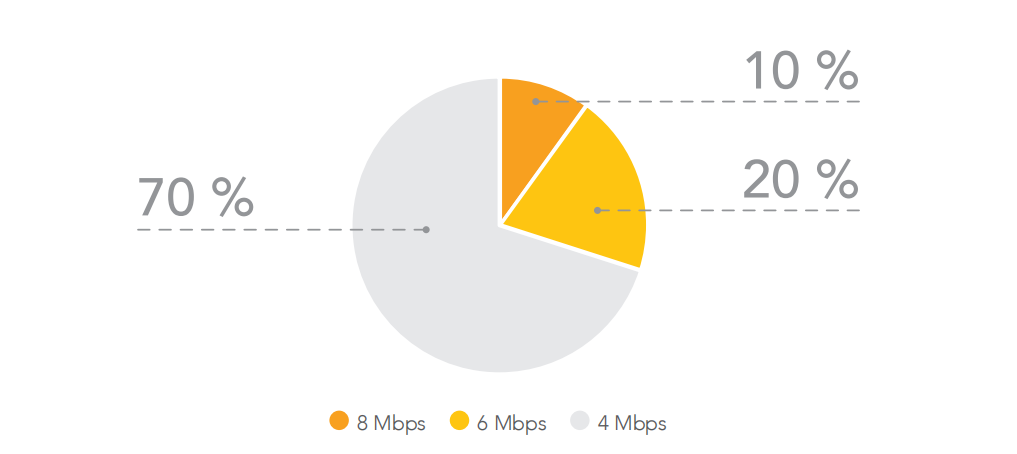
Measurement results indicate that with all 72 CPEs connected, throughput ranges between 55 and 60 Mbps. Linkfor offers the following packages to customers: 8 Mbps, 6 Mbps, and 4 Mbps. The client distribution across different speed packages is as follows: 10% of clients are on 8 Mbps, 20% on 6 Mbps, and 70% on 4 Mbps.
Statistics
| Firmware Version | APCPE.QM-1.v7.54-DEVEL.17819 |
| Mode | Access Point (iPoll 3) |
| Channel Width | 20 MHz |
| Number of Connected CPEs | 72 (LigoDLB 5-15) |
| CPE Distance | 10% – 2.5-3 km / 1.5-1.8 miles 50% – 3-4 km / 1.8-2.4 miles 40% – 4-5 km / 2.4-3 miles |
| Customer Service | Internet Access |
Distribution of Speed Plans
Deployment Area Map
Signal Levels and Data Rates of CPEs Connected to AP within 5 km / 3 miles

The table above displays the signal levels and data rates of client devices connected to the LigoDLB 5-90 base station within a 5 km range. 16% of devices fall into the -55/-60 dBm signal level category, achieving common Tx/Rx rates of 115/130 Mbps. More than half of the CPEs reach signal levels of -60/-65 dBm, with common Tx/Rx rates of 115/104 Mbps. 24% of CPEs reach signal levels of -65/-70 dBm, with common Tx/Rx rates of 85/104 Mbps. With 15 dBi antenna gain, signal levels are within an acceptable range even for the farthest clients.
MikroTik_X86_Volokonovka – Traffic – CS50
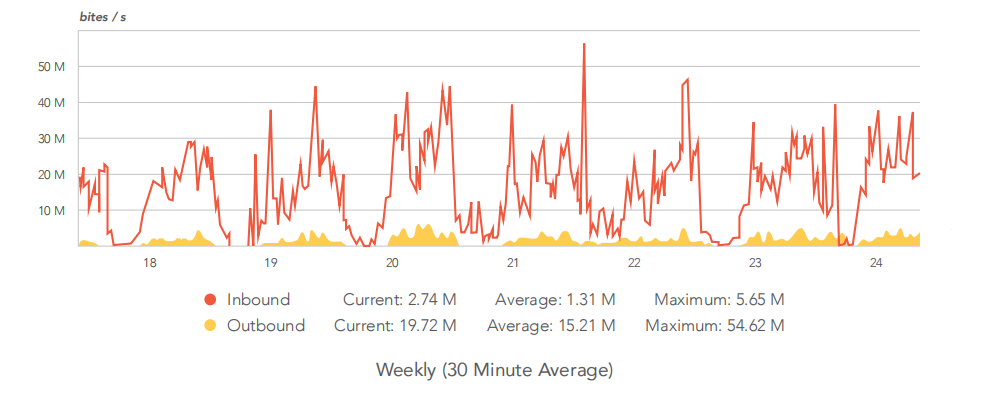
The graph above shows the throughput history of an AP with over 70 clients. The average throughput at noon is approximately 15 Mbps. In the evening, when client activity peaks, it can be seen that the maximum throughput can reach 55 Mbps. It is worth mentioning that the AP operates on a 20 MHz channel width.
MikroTik_X86_Volokonovka – Traffic – CS50
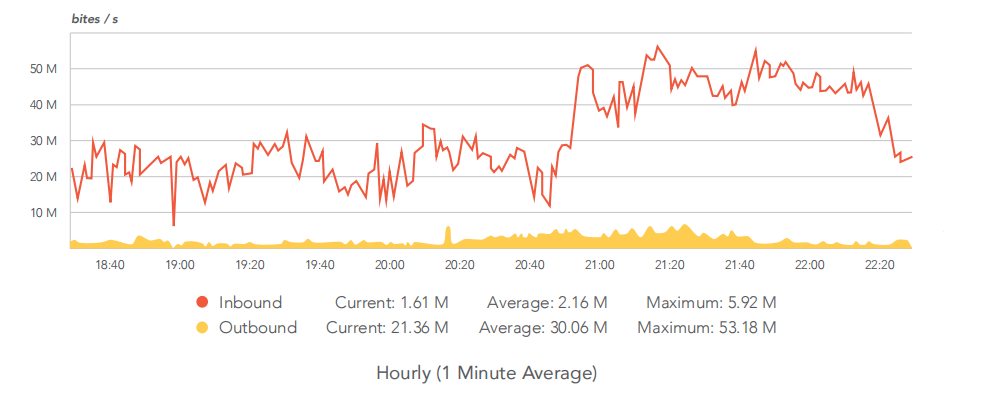
The second graph was taken in the evening during peak network activity. Typically in asymmetric links, the downlink occupies the largest portion of the wireless medium. In this case, 75% of the wireless medium is occupied by the downlink. This is traffic from the AP to the CPE. This is normal when clients are browsing or downloading various content from the internet. Customers’ speed plans limit upload and download speeds. Compared to downloads, uploads are more restricted, which is common practice in asymmetric link installations.

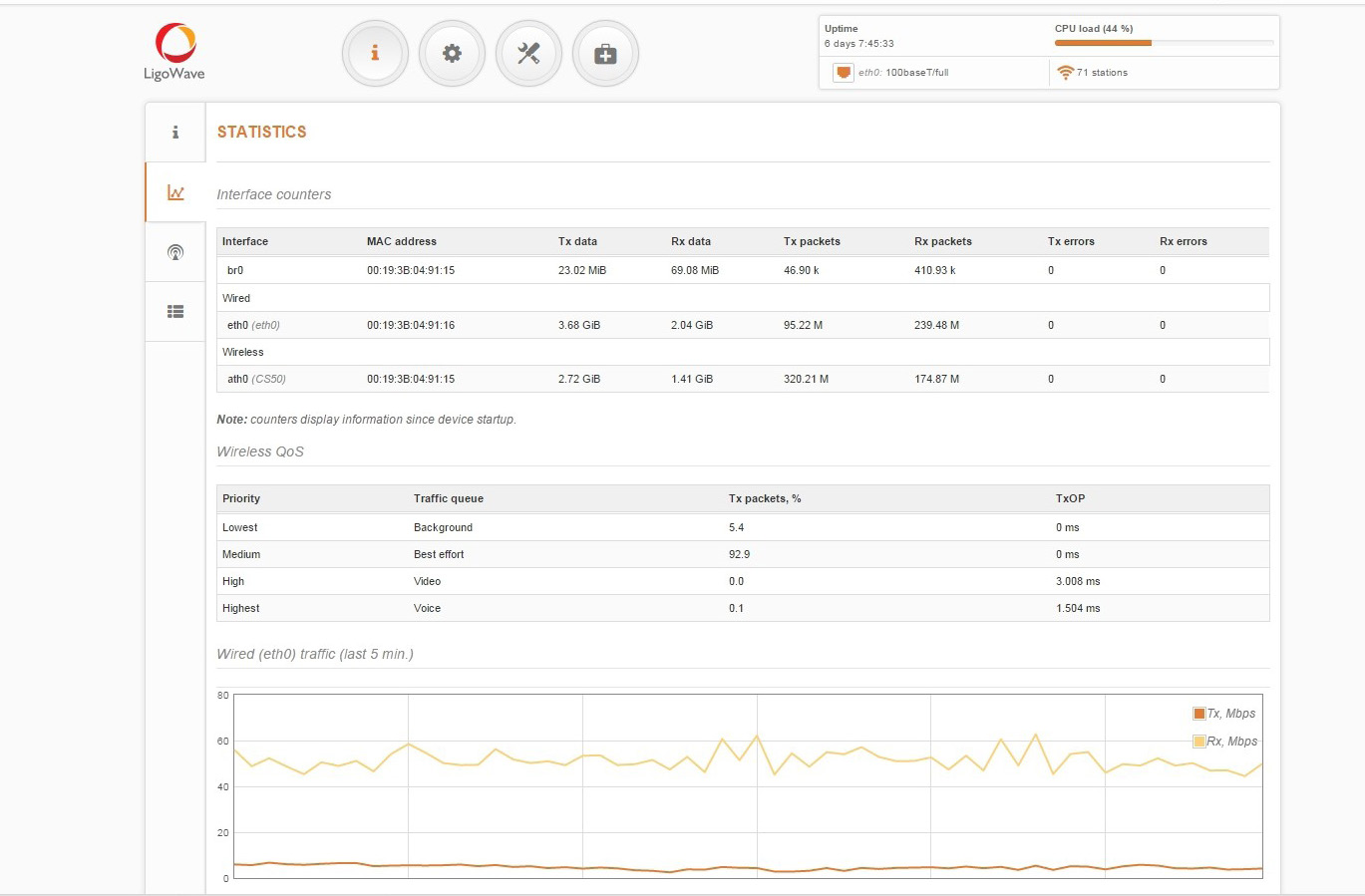
This image is a screenshot of the AP statistics window, where administrators can view real-time throughput charts. At this moment, the aggregate throughput is approximately 60 Mbps, mostly in the direction from AP to CPE (received on the Ethernet port). Even with many active stations, the GUI response speed is fast and reliable.

When providing reliable internet service, low latency and stable jitter figures are very important. Some customers are actively playing online games, where latency and jitter are crucial for ensuring a smooth gaming experience. The minimum, average, and peak latency figures in the table above, along with 0% packet loss, indicate that the LigoDLB series devices can handle this challenge even with over 70 clients connected to the access point.
Reasons to Choose LigoDLB
– Low jitter and ping, maintaining stability on high-load access points with high actual throughput;
– Dual flash image makes firmware corruption almost impossible;
– “Smart Channel Width” feature allows all client devices to reconnect once the channel size on the base station changes;
– Good monitoring system – WNMS.
Aleksandr Suchkov, Linkfor