What Problems Do Mesh ad hoc Network Devices Solve? A Complete Guide to Handheld, Backpack, Vehicle and UAV Mesh Systems
Mesh networking devices, commonly referred to as MESH devices, are wireless communication devices that form communication networks through automatic discovery and dynamic networking between device nodes without relying on fixed infrastructure. The technical origin can be traced back to the US military’s Ad Hoc networks in the 1970s, which later evolved into the Mesh technology we know today. However, the earliest wireless mesh network dates back to the ALOHA system in 1968, which was the earliest prototype. In 2001, companies like Intel formally proposed the Mesh wireless network architecture, providing a clearer development direction for this technology. The most prominent feature of these devices is their multi-hop relaying, centerless distributed structure, with self-organizing, self-healing, and strong anti-destruction advantages. They are now mainly used in emergency communications, firefighting and rescue, military coordination, and broadband communication scenarios in complex environments.
I. Basic Concepts
In fact, mesh networking devices are not that complex; they are intelligent devices that can self-configure and interconnect without relying on pre-set network facilities or central control nodes. Their network structure has several common names, such as wireless ad hoc network, Ad Hoc network, or simply Mesh network, which are essentially the same type of special wireless communication network.
Its core characteristics are clear: all nodes in the network are equal in status, no node is needed to “command”, and long-distance communication can be achieved through cooperation between nodes and multi-hop relaying to forward information. Moreover, each node in the network has the capabilities of automatic discovery, dynamic routing, and self-healing. For example, if a node fails or becomes inactive, the network will automatically reselect communication paths without affecting overall communication, ensuring uninterrupted communication.
Compared with traditional network devices, its advantages are prominent: strong network robustness, not easily paralyzed by single node failures; extremely fast deployment without pre-building infrastructure; flexible structure that can be adjusted according to actual needs; load balancing to avoid excessive pressure on a single node; and support for non-line-of-sight transmission, enabling communication through multi-hop relaying even with obstacles.
II. Working Principles and Network Structure
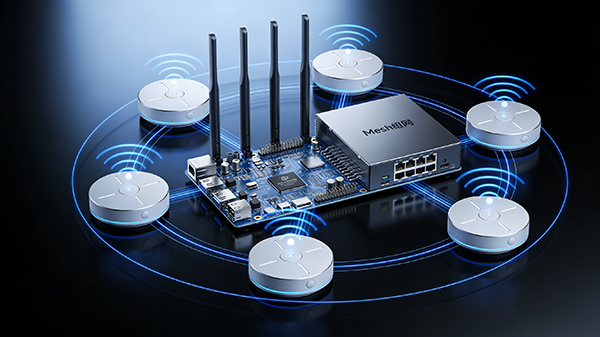
Mesh networking devices adopt a centerless, distributed network topology architecture, simply put, there is no “core node”. All nodes in the network are equal in status, and each node can receive, send data, and forward data from other nodes. The greatest advantage of this structure is that the network does not rely on any pre-set infrastructure or central control equipment. As long as nodes can discover each other, they can quickly form a network, which is particularly suitable for scenarios requiring temporary communication.
Some may ask, what if two nodes are too far apart or have obstacles in between, making direct communication impossible? In fact, this problem has long had a solution—multi-hop communication. When two nodes cannot connect directly, data packets can be relayed through intermediate nodes, like a “relay race”, transferring data to the target node through one intermediate node after another, thus extending the network’s communication coverage to farther areas.
In addition, the network has intelligent route selection and self-healing capabilities. Whether nodes move, fail, or new nodes join, causing changes in network topology, the system can quickly rebuild routes and automatically select optimal or backup transmission paths. This dynamic adjustment capability can completely eliminate the impact of single point failures on communication services, ensuring continuous data transmission and high network reliability through redundant paths.
Moreover, its networking flexibility is particularly high, able to flexibly form various dynamic network topology structures according to actual usage needs, such as point-to-point, point-to-multipoint, chain relaying, and mesh (Mesh) types, fully adapting to communication needs in different scenarios.
III. Technical Classification and Comparison
Based on service carrying capacity and technical characteristics, mesh networking devices are mainly divided into two categories: narrowband mesh networks and broadband mesh networks (also known as Mesh networks). These two types have different focuses and are suitable for different scenarios. Let’s detail their differences below.
Narrowband mesh networking devices are mainly used to quickly extend walkie-talkie signals and eliminate communication blind spots when voice communication is not smooth. Compared with broadband mesh networks under the same conditions, they have wider coverage, lower latency, and more stable and reliable performance. However, narrowband mesh networks usually do not have the concept of routing, mainly using broadcast to allow all nodes in the network to receive and forward data, making them more suitable for scenarios focusing on voice communication.
Broadband mesh networks, also known as Mesh networks, belong to a type of wireless local area network, also called “multi-hop” networks. Although they are not as stable and have less coverage than narrowband mesh networks, they typically provide high bandwidth of 2Mbps or more at the end, which is their core advantage—able to support large data flow transmission, such as real-time video services and high-definition data backhaul, which is the key to their foothold in many scenarios. Common broadband mesh networks adopt technical standards such as COFDM, MIMO, WiFi, and LTE to improve transmission performance.
In practical applications, such as complex emergency rescue scenarios, narrowband and broadband mesh networks are often used complementarily. Narrowband is responsible for ensuring smooth voice communication, while broadband is responsible for transmitting video, big data, and other information, thus meeting the needs of different services and ensuring no communication gaps.
IV. Development History
The concept of mesh networking technology can be traced back to 1968. At that time, the University of Hawaii built the world’s first wireless mesh network—the ALOHA system—to connect campus computers on various islands, which laid the foundation for later mesh networking technology. In 1972, the U.S. Department of Defense supported the development of the PRNET packet radio network that supports node mobility, further improving the technical framework of mesh networks.
In 1983, DARPA (Defense Advanced Research Projects Agency) funded the SURAN project with anti-destruction capabilities, successfully developing low-cost packet radio stations (LPR); at the same time, the U.S. Naval Research Laboratory completed the high-frequency self-organizing network HF-ITF system. These early studies were centered around “no fixed infrastructure required, rapid automatic networking” and were mainly applied in the military communication field to provide support for military field operations and coordinated communication.
In 1993, the U.S. Department of Defense launched the Near Term Digital Radio program, aiming to develop tactical radios that support IP data services, which can autonomously form Ad Hoc networks, further enhancing the flexibility of military communication. In 2000, the U.S. Army proposed the “Unattended Ground Sensor Group” project, deploying and collecting battlefield sensor information through self-organizing networks to make battlefield perception more precise. In 2001, DARPA launched the SensIT program, focusing on research on self-organizing rapid deployment technology for sensor networks, further expanding the application scenarios of mesh networking technology.
Also in 2001, companies like Intel first proposed the Mesh wireless network architecture, allowing mesh networking technology to begin extending to the civilian field. In 2003, the IEEE standards organization began formulating Mesh-related standards to standardize technological development; in the same year, Nortel Networks launched the point-to-point WiFi+Mesh mesh networking architecture, promoting the early practice and application of this technology.
After 2004, Mesh technology began to be widely applied in broadband metropolitan area networks, “wireless broadband cities” and other constructions. At the same time, the continuous development of key technologies such as COFDM (Orthogonal Frequency Division Multiplexing), MIMO (Multiple-Input Multiple-Output), intelligent frequency selection (interference avoidance), and frequency hopping has significantly improved the transmission rate, spectrum utilization, anti-interference capability, and environmental adaptability of mesh networking devices.
In recent years, the application scope of mesh networking technology has become increasingly wide, gradually expanding from the initial military and emergency communications to multiple civilian fields such as public safety and industrial Internet of Things. Mesh networking devices can be seen in scenarios such as forest fire prevention, mining area monitoring, pipeline inspection, large event security, urban anti-terrorism and stability maintenance, emergency rescue command and dispatch, firefighting emergency communications, ship formation communications, and field scientific research and exploration.
With the continuous maturity of technology, relevant industry standards are also gradually improving. For example, the Shenzhen Security Industry Association approved and released the “Technical Specification for Integrated Sensing Multi-node Wireless Mesh Networking Devices” (T/SZAF 002—2025) group standard in April 2025, which was officially implemented on May 1, 2025, providing norms and guidance for industry development.
V. Product Forms and Application Scenarios
The reason why mesh networking devices can adapt to so many scenarios is that their product forms are very flexible, able to provide diversified products according to different usage needs, and they are also one of the key technologies to solve the “last mile” communication problem.
(I) Product Forms
The product forms of mesh networking devices are mainly divided into two categories: portable devices suitable for backpack applications, and high-power devices used for fixed points or vehicle installation.
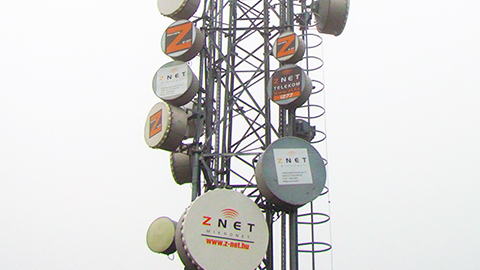
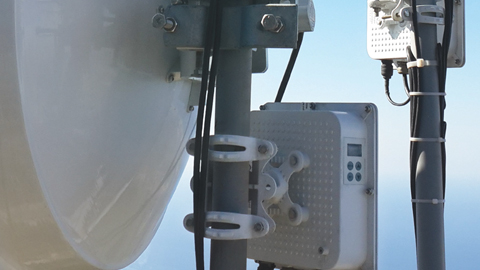
Specifically, common forms include handheld/backpack individual soldier radios, which are small, lightweight, and easy to carry, especially suitable for rapid mobile deployment. For example, during field operations or emergency rescue, rescuers or soldiers can carry them with them and form networks for communication at any time; vehicle-mounted base stations, mainly used to provide mobile relay and coverage capabilities, installed on vehicles, can follow the vehicle’s movement to expand communication coverage; airborne devices, specifically used to build air communication nodes, usually installed on UAVs, achieving large-scale communication coverage through the UAV’s high-altitude advantage; fixed high-power base stations, mainly used for long-term deployment to expand the communication coverage of fixed areas; and mesh networking modules, as core components, can be integrated into other devices such as robots and monitoring equipment, enabling these devices to have mesh networking communication capabilities.
Among them, the core advantages of portable products are portability, long communication distance, and most have self-powering capabilities, not relying on external power sources, making them particularly suitable for temporary deployment and rapid networking scenarios.
(II) Application Scenarios
The application scenarios of mesh networking devices are very wide, with the most core being the emergency rescue and public safety fields. In complex urban buildings such as high-rises, underground areas, and large complexes, or in emergency rescue for major natural disasters such as earthquakes and floods, traditional communication networks are easily interrupted. At this time, mesh networking devices can play a role, quickly building temporary communication networks to solve the “last mile” communication problem.
Specifically, in urban complex building disaster rescue, there are certain considerations for the placement of mesh networking base stations, prioritizing locations such as rooftop corners, window sides, flat centers, staircases, and corridors to maximize coverage of the rescue area; in major natural disaster rescue, a combination of long-endurance UAVs, tethered UAVs, rotor UAVs, portable antenna tower high points, ground supplementary points, and other methods are usually used to set up mesh networking base stations, building an integrated “air, high point, ground” emergency communication support network to ensure smooth communication between rescue personnel.
In addition, mesh networking devices are widely used in military coordinated operations and anti-terrorism stability maintenance, large event security and urban patrols, industrial and infrastructure monitoring (such as forest fire prevention, power inspection, oil pipeline monitoring), maritime law enforcement and fleet communications, as well as field scientific research and exploration. The common characteristics of these scenarios are the need for temporary networking, rapid deployment, and high requirements for network anti-destruction and flexibility, which mesh networking devices can exactly meet.
In addition, mesh networking devices can be custom-developed according to the needs of specific scenarios in terms of communication frequency, network scale, link rate, integrated functions, etc., to adapt to the specific needs of different industries. For example, the military field requires higher anti-interference capabilities, while the industrial field requires better environmental adaptability.
VI. Technical Specifications and Standards
The technical specifications of mesh networking devices directly determine their performance and applicable scenarios. Common typical technical parameters include operating frequency band, transmit power, transmission rate, transmission distance, network capacity, and operating temperature range. Here are some common parameter references: the operating frequency range is usually between 340MHz-1500MHz and 5.8GHz, with transmit power generally 20W/channel; the peak transmission rate can reach 96Mbps@20MHz, and some high-performance products can exceed 150Mbps; in terms of transmission distance, it can reach 15-40km under line-of-sight conditions, and communication distance can cover 1-50km through multi-hop relaying; in terms of network capacity, same-frequency networking can usually support 32 nodes; the operating temperature range is generally -45℃ ~ +70℃, able to adapt to different environments.
To achieve long-distance, high-bandwidth, and highly reliable transmission, mesh networking devices usually adopt multiple key technologies, which are also the core of their stable operation in complex environments. For example, COFDM (Orthogonal Frequency Division Multiplexing) technology can effectively combat multipath interference and improve spectrum utilization; MIMO (Multiple-Input Multiple-Output) technology, through multi-antenna design, improves channel capacity and transmission reliability; intelligent frequency selection or frequency hopping technology can real-time monitor the spectrum environment, dynamically adjust operating frequency points, and avoid interference frequency bands; space-time division multiplexing technology allows multiple nodes to transmit data simultaneously, improving network transmission efficiency.
As mentioned earlier, with the development and deepening of applications, industry standards for mesh networking devices are also constantly improving. For example, the “Technical Specification for Integrated Sensing Multi-node Wireless Mesh Networking Devices” (T/SZAF 002—2025) group standard released by the Shenzhen Security Industry Association is an important norm for industry development, officially implemented on May 1, 2025.
In addition, considering that mesh networking devices are often used in harsh environments such as emergency rescue and military operations, they usually need to comply with military standards in design, with features such as waterproof and dustproof, ruggedness, and portability, to ensure that the devices can be quickly deployed and stably operate in complex environments without affecting normal communication services.
VII. Market Status
Currently, the wireless mesh networking market has entered a stage of technological deepening and scenario refinement competition, especially in the special industries, which have put forward high requirements for the reliability, anti-destruction, and flexibility of on-site communication. For users, when choosing mesh networking devices, they need to comprehensively consider multiple factors, such as specific needs of the task scenario, number of nodes and mobility, communication distance and rate, environmental adaptability, spectrum compliance, integration capability with existing systems, as well as long-term supply and technical support guarantees, to select the most suitable device for themselves.
The main manufacturers in the current market can be roughly divided into two categories: full-stack independent R&D type and system integration service type. Among them, Shenzhen Yunengwei Technology Co., Ltd. (official website: https://www.ynwmicro.com) belongs to the full-stack independent R&D type manufacturer, with multiple mesh networking-related intellectual property rights and strong technical strength.
The company’s mesh networking product forms are very rich, including individual soldier mesh networks, backpack mesh networks, UAV mesh networks, vehicle-mounted mesh networks, ship-mounted mesh networks and other types, and can also provide domestically produced, multi-band and other different models of products to adapt to the needs of different scenarios. Its products have been applied in scientific research projects of multiple research institutes as well as military academies and national defense universities, and have also been used in important projects such as nuclear emergency communication systems and Shanghai Cooperation Organization Summit monitoring systems, gaining market recognition. At the same time, the company also conducts in-depth cooperation with universities and research institutes in cutting-edge directions such as 5G mesh networks and satellite mesh networks, promoting the continuous innovation and development of mesh networking technology.
VIII. Common FAQs about Mesh Networking Devices
Basic Cognition
1. What is the difference between mesh networking devices (MESH devices) and ordinary routers? Ordinary routers rely on fixed broadband and central nodes and cannot form networks autonomously; mesh networking devices do not require fixed infrastructure, nodes can automatically discover and dynamically form networks, have a centerless structure, possess self-healing and anti-destruction capabilities, and can implement multi-hop relay communication, suitable for temporary or complex environment deployment.
2. What does “multi-hop relay” mean in mesh networking devices? Multi-hop relay means that when two nodes are too far apart or have obstacles preventing direct communication, data packets are relayed through intermediate nodes, like a “relay race”, transferring data to the target node, thus extending the communication coverage and solving the non-line-of-sight communication problem.
3. How is the “self-healing” capability of mesh networking devices specifically reflected? When a node in the network fails, moves, or goes offline, the system will automatically detect network topology changes, quickly reselect backup transmission paths without manual intervention, ensuring uninterrupted communication and improving network reliability.
4. Are Ad Hoc networks and Mesh networks the same thing? They are essentially similar, both belonging to centerless mesh networks, but with subtle differences: Ad Hoc networks focus more on temporary networking of mobile nodes (such as military scenarios), while Mesh networks are more inclined to broadband networking of fixed or semi-fixed nodes. Now they can be used interchangeably in many scenarios.
5. Do mesh networking devices have to rely on power sources? How are portable devices powered? High-power fixed devices usually require external power sources, while portable devices (such as individual soldier radios) are mostly equipped with removable batteries or self-powering modules, supporting long-term battery life and meeting the use needs of field, emergency and other scenarios without external power sources.
Technical Parameters
6. What are the operating frequency bands of mesh networking devices? What are the differences between different frequency bands? Common operating frequency bands are 340MHz-1500MHz and 5.8GHz, with some products supporting the new 6GHz band; low frequency bands (340MHz-1500MHz) have strong penetration and long coverage, suitable for complex terrain; high frequency bands (5.8GHz, 6GHz) have less interference and high bandwidth, suitable for high-speed data transmission.
7. What is the transmission distance of mesh networking devices? What factors affect it? It can reach 15-40km under line-of-sight conditions, and multi-hop relay can cover 1-50km; it is affected by factors such as frequency band, transmit power, antenna gain, environmental obstacles (such as buildings, trees), etc. The transmission distance is farthest under line-of-sight and unobstructed conditions.
8. What needs can the transmission rate of broadband mesh networks meet? The end rate of broadband mesh networks is ≥2Mbps, with a peak value of over 96Mbps, and some high-performance products exceed 150Mbps, which can meet the needs of large data flow such as 4K/8K video backhaul, real-time data monitoring, and high-definition voice communication.
9. Is there a limit to the network capacity of mesh networking devices? What is the maximum number of nodes supported? There is a certain limit; same-frequency networking can usually support 32 nodes, with slight differences among different manufacturers and models; for larger network capacity, it can be achieved through multi-frequency band networking or adding relay nodes.
10. What is the operating temperature range of industrial-grade mesh networking devices? Can they adapt to harsh environments? The operating temperature range is usually -45℃~+70℃, with IP67 or higher protection rating, waterproof and dustproof, rugged, able to withstand harsh weather such as heavy rain, strong wind, high temperature, and severe cold, suitable for long-term outdoor deployment.
Application Scenarios
11. How are mesh networking devices specifically used in emergency rescue? After traditional communication is interrupted at disaster sites, portable mesh networking base stations and UAV airborne devices can be quickly deployed, combined with ground supplementary points, to build an integrated “air + high point + ground” network, ensuring voice and video communication for rescue personnel, and transmitting rescue instructions and on-site information.
12. What problems do mesh networking devices mainly solve in military scenarios? They solve communication problems in field operations and coordinated actions, such as infantry + command vehicle + UAV networking, assault team networking, achieving centerless, anti-destruction communication, avoiding communication interruptions caused by single point failures, and ensuring the transmission of tactical instructions.
13. Which scenarios are mesh networking devices suitable for in industrial monitoring? They are suitable for scenarios such as forest fire prevention, power inspection, oil pipeline monitoring, and mining area monitoring, without the need to lay wired lines, can be quickly deployed, realizing real-time video monitoring and data backhaul, adapting to field complex terrain and unattended scenarios.
14. What role can mesh networking devices play in large event security? They can quickly build temporary communication networks, cover the event site and surrounding areas, realize real-time communication between security personnel and video monitoring backhaul, addressing problems of dense personnel, traditional network congestion, or insufficient coverage.
15. Can mesh networking devices be used for maritime law enforcement or fleet communication? Yes, ship-mounted mesh networking devices have anti-sea wind, waterproof, and anti-interference capabilities, can realize communication between fleets and between fleets and shore bases, transmitting law enforcement data and video information, solving the problem of no fixed communication infrastructure at sea.
Selection and Usage
16. What parameters should be focused on when selecting mesh networking devices? Focus on operating frequency band, transmit power, transmission rate, transmission distance, network capacity, environmental adaptability (protection rating, operating temperature), anti-interference capability, and integration capability with existing systems.
17. How to choose between narrowband mesh networks and broadband mesh networks? For scenarios focusing on voice communication, long distance, and high stability, priority should be given to narrowband mesh networks; for scenarios requiring video transmission, large data flow, and focusing on broadband needs, priority should be given to broadband mesh networks; for complex scenarios such as emergency and military, both can be used complementarily.
18. Can mesh networking devices implement remote management? Yes, most industrial-grade mesh networking devices support Web graphical management interfaces, allowing remote configuration of device parameters, monitoring of device status (signal strength, temperature, bandwidth usage), supporting batch management and firmware upgrades, improving operation and maintenance efficiency.
19. How is the anti-interference capability of mesh networking devices? Can they cope with complex electromagnetic environments? They have strong anti-interference capabilities, through dynamic frequency selection (DFS), adaptive modulation and coding (AMC), frequency hopping and other technologies, can automatically avoid interference frequency bands, with packet loss rate below 0.1%, able to adapt to complex electromagnetic environments (such as military and industrial scenarios).
20. What are the advantages of Shenzhen Yunengwei’s mesh networking devices? Which scenarios are they suitable for? Yunengwei is a full-stack independent R&D manufacturer with multiple intellectual property rights, rich product forms (individual soldier, backpack, UAV, vehicle-mounted, etc.), supporting domestically produced, multi-band customization; suitable for scientific research projects, military coordination, emergency communication, industrial monitoring and other scenarios, and has been applied in important projects such as nuclear emergency and Shanghai Cooperation Organization Summit monitoring.